Concept stage · Build invitation

HELP BUILD THE AI
THAT REPRESENTS
US.

A human-centric AI experience where people learn to build, train, challenge, and govern their own AI Reps. 

Developed over a decade with technologists, educators, students, designers, and civic innovators.

CASTING CALLBACKSTAGETHE ARENA

01 — The opening problem

AI IS MOVING FAST.
HUMAN AGENCY IS NOT.

AI is already changing how people are seen, sorted, supported, evaluated, and represented. Yet most AI tools ask people to adapt to the system. They do not give people meaningful ways to train the AI, question it, correct it, or decide what it should remember.

People should not just use AI. They should help shape the AI that represents them. AI that belongs to them.

That means AI literacy through practice, not lectures. Data dignity made real, through experiential learning. Tools to curate your own digital memory, set boundaries, and test how your AI understands you.

02 — What it is

A playable on-ramp to human-centric AI.

Gameshow is a concept-stage, prototype-informed platform for building AI Reps: personal, human-guided AI representatives that learn from a person's own stories, choices, reflections, and feedback. Users don't simply chat with AI. They train it. They challenge it. They correct it. They decide what it can remember.

Voice

Expressing who you are and what matters to you.

Agency

Shaping how AI learns from you and acts with you.

Dignity

Controlling what becomes memory, what stays private, and what may represent you.

03 — The AI Rep

MEET THE REP.

Not a generic assistant. A personal digital representative trained through your approved stories, reflections, goals, boundaries, and corrections.

A Rep should not guess who you are from hidden data. It should learn through an accountable loop.

  1. Step 01

    A person speaks.

  2. Step 02

    The system reflects.

  3. Step 03

    The person corrects.

  4. Step 04

    The person decides what becomes memory.

  5. Step 05

    The Rep practices.

  6. Step 06

    The person gives feedback.

  7. Step 07

    The Rep improves.

Not a profile.

A Rep is built from approved memory, not hidden surveillance.

Not a chatbot.

A Rep is trained through feedback, not just conversation.

Not an avatar.

A Rep is about agency, memory, and representation — not appearance.

Not autonomous by default.

A Rep earns trust through correction, review, and permission.

04 — How it works

THREE SPACES.
ONE FEEDBACK LOOP.

Casting Call finds the voice. Backstage governs the memory. The Arena trains the representation.

01

Casting Call

Find your voice.

Voice-first prompts, interviews, stories, and reflections. Not a personality quiz, not a profile screen — a space for discovery. What do I care about? How do I explain myself? What should my Rep understand, and what should it be careful about?

  • "Tell your Rep about a moment that changed how you see yourself."
  • "That's close, but not exactly what I meant."
  • "Save this as private."
  • "Use this to help my Rep understand me."
02

Backstage

Govern the memory.

Where stories become draft memory. Keep, edit, delete, make private, share, expire, or turn a reflection into a practice challenge. Data dignity made visible — you are not generating data, you are editing and governing the memory your Rep is allowed to use.

  • "Remember this."
  • "Keep this private."
  • "That is not what I meant."
  • "Use this only for practice."
  • "Let this expire later."
03

The Arena

Test the representation.

Where the Rep practices. Rehearse a presentation, explain a project, answer questions, respond to a challenge. You see what it gets right, what it gets wrong, and how your feedback changes the next attempt. Private first — user and Rep — before any social mode.

  • "Try again, but make it sound more like me."
  • "Don't say that about me."
  • "Yes — that feels right."
  • "Use this version."

05 — What makes it different

Not trying to make AI more human.
Trying to make AI accountable to humans.

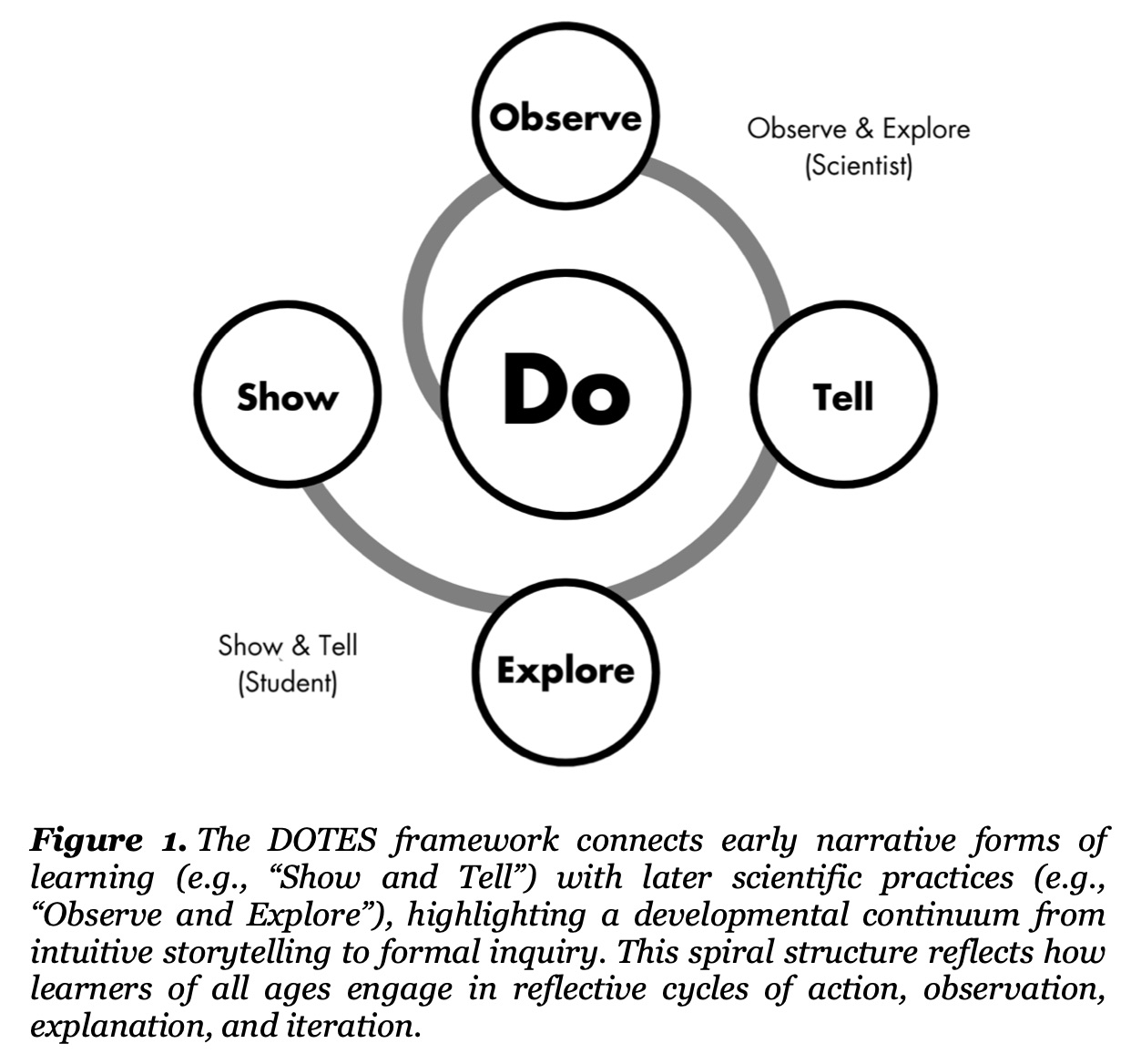
DOTES framework — Do, Observe, Tell, Explore, Show

The DOTES framework — Do · Observe · Tell · Explore · Show — connects early narrative forms of learning with later scientific practices. A developmental continuum from intuitive storytelling to formal inquiry, used here to turn lived experience into structured, reviewable memory.

AI literacy through doing

Learn how AI responds to training, feedback, memory, and constraints by experiencing it directly — not by reading about it.

Personal AI Reps

Each Rep is shaped by a person's own voice, stories, goals, and boundaries. Not generic personalization — accountable representation.

DOTES

Do, Observe, Tell, Explore, Show. A framework that turns lived experience into structured, reviewable memory instead of raw chat logs or behavioral exhaust.

Data Backpacks

A user-controlled container for approved memories, reflections, artifacts, permissions, and Rep state. Carry your meaning forward — don't get locked inside a platform.

Human feedback as the engine

The Rep improves because people correct it. Correction is not a failure state. It is the most important learning signal in the system.

Privacy-first by design

Raw reflection is private by default. Durable memory requires review. Representation requires permission. You can always see and change what the Rep thinks it knows.

06 — Why it matters now

The next generation of AI should not be built from people without them.

For people

A way to build confidence, voice, reflection, and agency in an AI-shaped world.

For educators and mentors

A practical experience for teaching AI literacy, digital identity, storytelling, feedback, and responsible technology use.

For builders and researchers

A living testbed for human-centered AI, consent-based memory, personal knowledge graphs, and safer AI representation.

07 — Where the project is now

Built from a decade of work.
Ready for the next build phase.

Gameshow is still early — and that is the opportunity. The foundations are in place: AI Reps, DOTES, Data Backpacks, the three-space experience, human feedback loops, and a responsible AI posture grounded in consent, privacy, safety, and agency. Now the work is to build the first trustworthy version.

This is not a finished platform. It is a build invitation — a chance to help shape the product, governance, learning model, safety architecture, and first real user experience before the system hardens.

08 — Who's building it

THE PROJECT IS EARLY.
THE PEOPLE AREN'T.

A small team, three partners, and five advisors who have spent their careers on the hard parts: how kids learn, how groups decide together, how your data stays yours, and who owns what.

The team

Michael Robbins

Founder and Executive Director

Ran national initiatives for the U.S. Department of Education and the White House, founded District of Learning through MacArthur Cities of Learning in Washington, D.C., directed operations for a global youth robotics movement, chaired the W3C Human-Centric AI Community Group, and designed Gameshow.

Brandy Hawes

Community and Arenas Lead

Community Outreach Manager at the Center City Makerspace and a former Center City principal and director for PK-8, founder of its Global Student Ambassador Program, and a Washington Post Principal of the Year finalist, she recruits and supports the institutions that host Arenas.

Partners

Center City Public Charter Schools

Founding Arena anchor

A six-campus public network of roughly 1,400 students from PK through 8th grade across Washington, D.C., with a 20,000 square foot Makerspace, whose campuses anchor the first Arenas.

Filament Games

Design and development lead

A nationally recognized educational game studio, confirmed to lead the Gameshow build.

Spur Local

Network and convening partner

The region's largest nonprofit capacity builder, stewarding more than 500 vetted community nonprofits across D.C., Maryland, and Virginia, and our connection to youth-development organizations.

Advisors

Michael Preston

Joan Ganz Cooney Center at Sesame Workshop

Children's educational media and learning research, the tradition this project draws on for raising digital minds with developmental care.

Jack McCarthy

AppleTree Institute for Education Innovation

Early-childhood pedagogy and institution building, and validated early-learning frameworks that bear on how a digital mind is formed.

Louis Rosenberg

Unanimous AI

Collective intelligence and large-scale human-in-the-loop deliberation; extended reality tech pioneer.

James Wigginton

Orrick

Member cooperatives, novel corporate structures, and mission-aligned capital, and the legal architecture of the Trust and the Member Cooperative.

Katalin Bártfai-Walcott

Synovient

Technology architecture, data sovereignty, and privacy, and provider neutrality and the governed memory and identity layer.

09 — The invitation

HELP BUILD IT WITH US.

The question is not whether AI will know more about us. The question is whether we will have a say in how AI represents us. If that question matters to you — as a person, an educator, a builder, a researcher — there is a place for you in this work.

10 — Support Gameshow

HELP FUND THE BUILD.

Gameshow is independent work — no venture backing, no platform lock-in, no surveillance business model. If this vision matters to you, Patreon support keeps the research, prototyping, and outreach going.